
Last week, I sat with a coaching client who has been on an extended career break.
She is capable. Intelligent. Spiritually inclined. And deeply exhausted.
As she spoke, it became clear that she was not simply “burnt out”. She was carrying what I often describe as octopus legs deeply etched into her heart, nervous system, and intellect. Old memories. Unprocessed grief. Silent disappointments. Narratives inherited from hustle culture and reinforced by self-blame.
She cried. She released. She allowed herself to feel what had long been suppressed.
Then she looked at me and said quietly, “I feel heavy. I am overwhelmed. I know what is happening, but I do not know how to feel lighter.”
Many professionals reading this will recognise that moment.
Not the chaos. But the knowing without the capacity to move forward.
This is where willpower fails. This is where productivity tools collapse. This is where spiritual bypassing becomes tempting.
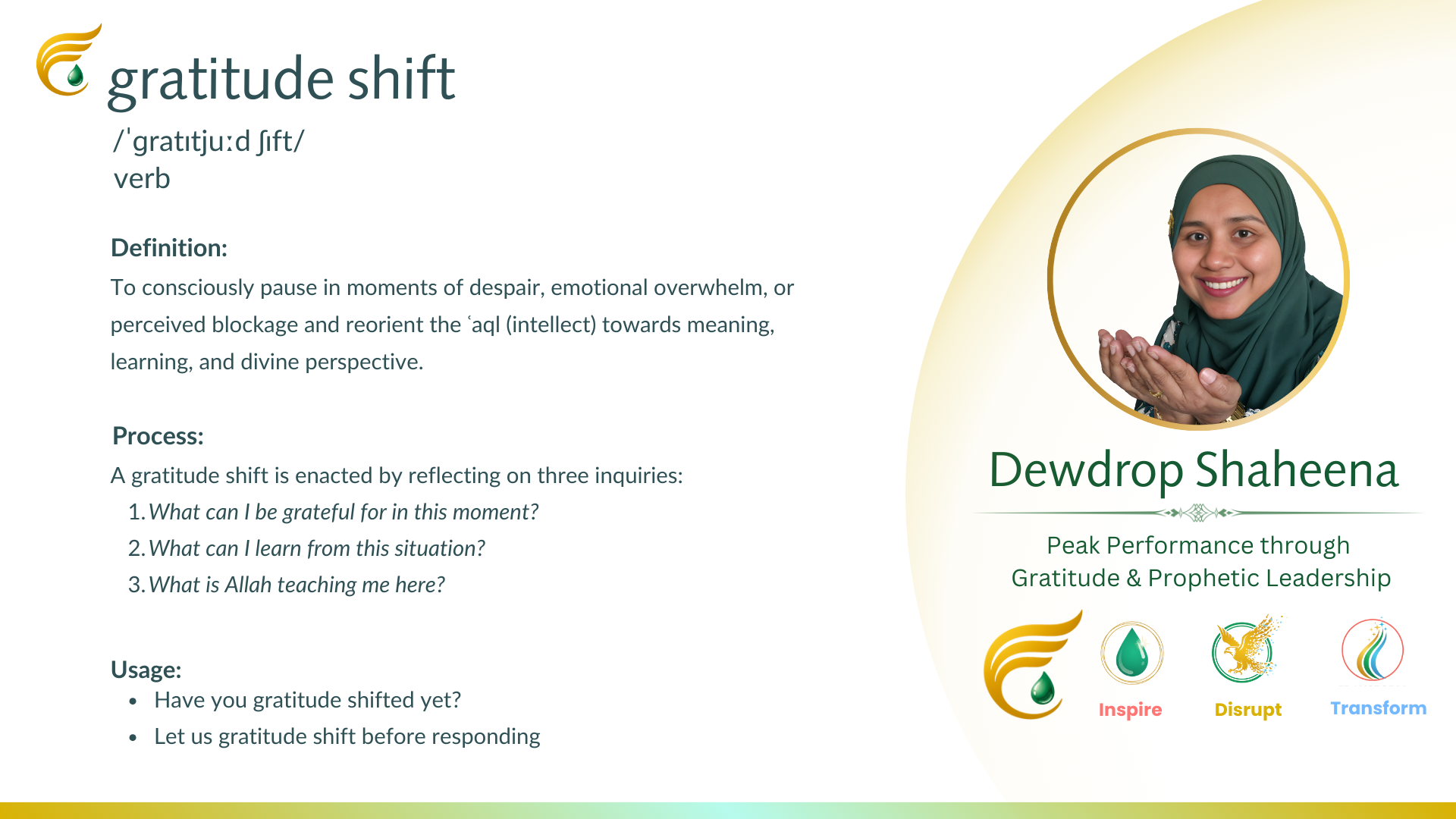
So we did not push. We gratitude shifted.
What Happens Before a Shift
Before I explain the process, let me name something important.
When someone is emotionally overwhelmed, their nervous system is often locked in a narrow frame of perception. In NLP, we might call this being stuck inside the problem frame. In lived experience, it feels like drowning while standing upright.
Later in the session, my client described it perfectly.
“When I came in,” she said, “I felt like the water was already at my neck. I was drowning, and it was reaching my nose.”
That imagery matters. Because the mind does not respond to logic when it is submerged. It responds to safety.
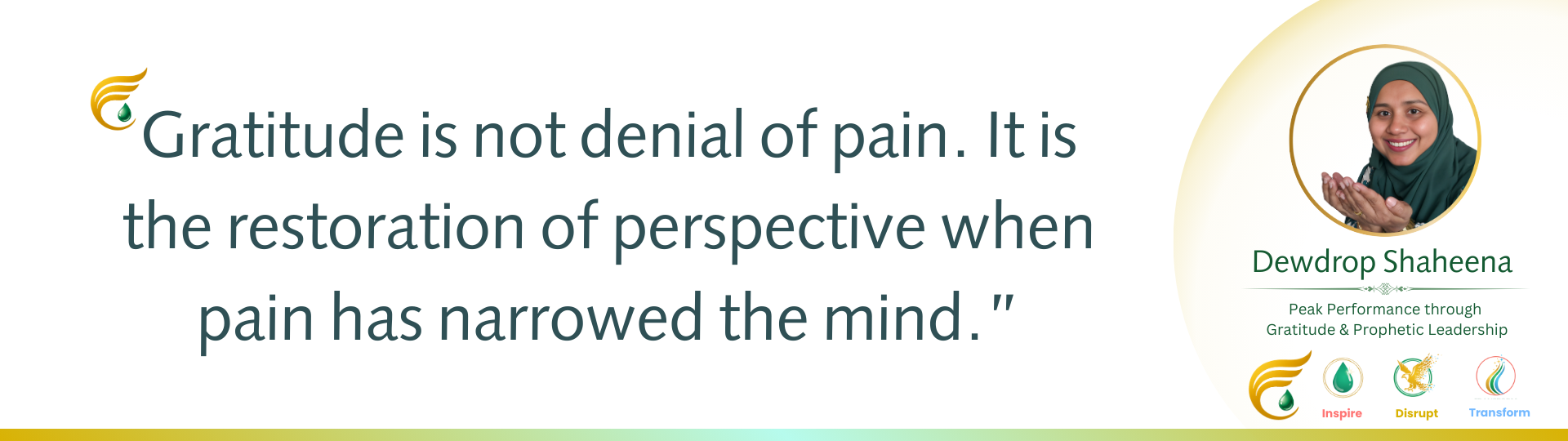
This is why gratitude, when applied correctly, is not positivity. It is regulation.
The First Question: What Can I Be Grateful for in This Moment?
We began gently, not with life goals, not with purpose, and not with pressure, but simply with this question. At first, she struggled, and that is normal. When the mind is flooded, it cannot see the horizon because it is standing too close to the problem, interpreting it as the whole landscape.
So I invited her to step back from what I call the “mole-made mountain”, the story that feels enormous only because we are standing right up against it. I asked her to imagine she was staring at a mountain through an open window, so close that it filled her entire field of vision. Then I invited her to take five steps back, slowly, and look again. Not through the full frame of alarm, but through the hinge, the narrow space that restores perspective. From that vantage point, I asked her to find just one thing she could be grateful for in that moment.
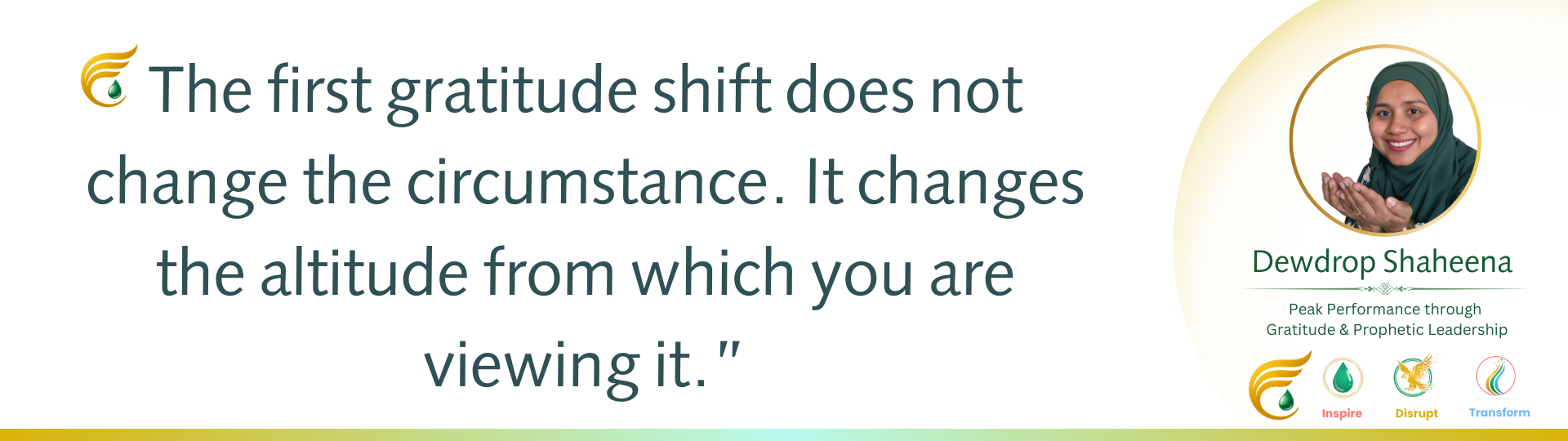
Slowly, she began to name what was still present: her breath, her eyesight, the safety of the room, the fact that she had a therapist, and the fact that she had a coach holding space. This is cognitive reappraisal in action. The intellect regains range, and the nervous system begins to exhale. Nothing external changed, and yet everything internal did.
This is where the gratitude shift begins.
The Second Question: What Can I Learn from This Situation?
Once the mind has space, meaning can emerge. After the first gratitude shift, her breathing slowed and her shoulders softened, as if her system had finally received permission to stand down from emergency mode. Only then did we move to the second question, not as a demand to “find the lesson”, but as an invitation to regain authorship over her experience.
We explored it gently, almost like turning a difficult situation in the light to see what it revealed from different angles. What might this season be showing you that you could not see when life was moving faster? What patterns were no longer sustainable, even if they once helped you survive? What expectations, identities, or illusions were quietly being dismantled so something truer could take root?
For many faith-driven professionals, burnout is not failure. It is information. It is the soul signalling misalignment long before the body enforces a stop. In that sense, learning becomes a form of mercy. It reframes suffering as stewardship and turns pain into a messenger rather than a life sentence.
The Third Question: What Is Allah Teaching Me Here?
Then we entered the third question, which shifts the centre entirely. It moves a person from self to submission, from control to trust, and from egoic striving to divine guidance. This is where the qalb softens, because the weight is no longer carried as a solitary burden. The hardship remains, but it is held differently, with reverence and perspective rather than panic.
We sat with the question slowly. Not everything needs to be fixed immediately. Some things need to be understood before they can be released. Some wounds do not respond to force, but they respond to meaning, to remembrance, and to the quiet realisation that Allah does not waste pain. When this question lands, it often restores a sense of coherence, as if the heart begins to reorient towards trust without needing to have every detail resolved.
Towards the end of the session, I asked a simple evaluative question: “On a scale of one to ten, how do you feel now?” She paused, as if scanning her body for the most truthful answer.
Then she said, “When I came in, I felt like I was stuck at neck level, drowning, with the water reaching my nose. Now I can breathe. I feel lighter.”
The water had receded, not because the storm had stopped, but because she was no longer drowning inside it.
Gratitude Shifting - A Prophetic Leadership Practice™
This is not a coaching trick, nor is it mindset hacking. It is Prophetic Leadership applied to modern burnout.
The Prophet ﷺ consistently taught his companions to pause, reflect, and restore meaning in moments of difficulty, rather than react from fear or impulse. Gratitude shifting is a structured way of embodying that sunnah within the nervous system, allowing the intellect and heart to return to clarity before action is taken.
The Qur’an establishes gratitude not merely as an emotional response, but as a principle of increase and expansion. Allah says in Surah Ibrahim (14:7): “If you are grateful, I will surely increase you.” Not only in provision, but in clarity, resilience, and capacity. Gratitude, therefore, is not passive acceptance. It is an active spiritual orientation that changes how pressure is processed and how leadership is exercised.
When gratitude is present, perception widens, the chest expands, and decisions are made from trust rather than scarcity.
For faith-driven professionals seeking faith-aligned income, personal brands with barakah, coaching or speaking paths rooted in integrity, and peak performance without spiritual erosion, gratitude shifting becomes a daily leadership discipline. It trains leaders to interpret pressure through divine perspective rather than egoic urgency. Because how you interpret pressure determines how you lead under it, gratitude becomes the bridge between spiritual anchoring and sustainable performance.
A Reflection for You
Pause for a moment. Before you scroll. Before you respond. Before you solve.
Ask yourself, gently:
-
What can I be grateful for in this moment?
-
What might this situation be teaching me?
-
What is Allah inviting me to see differently?
You do not need to answer perfectly. You only need to begin.
I Invite You to Reflect and Share
If this resonated, I invite you to comment below:
-
What did you notice as you read this?
-
Have you experienced a moment where a pause changed everything?
-
What would a gratitude shift look like in your current season?
Your reflection may be exactly what someone else needs to read today.
And if you are ready to learn how to apply Gratitude Shifting - A Prophetic Leadership Practice™ intentionally within your leadership, healing, or career transition, reach out.
This is how we lead with faith. This is how we perform without depletion. This is how we return to ourselves.
Feeling inspired?
Discover how my frameworks can help you turn insight into impact.
