
Peak performance does not collapse because people stop showing up.
In Jeddah-based professionals I work with, burnout rarely announces itself through absence or disengagement. It begins quietly, while people are still present, still capable, and still meeting expectations, but no longer carrying the work with a sense of meaning or ownership.
This is where many high-performing leaders feel confused. The team looks fine on paper. Meetings run on time. Targets are tracked. Yet energy feels flat, ideas are restrained, and the leader senses they are carrying the thinking alone. When pressure rises, the instinct is to push harder. Unfortunately, that is how burnout accelerates, and peak performance erodes.
The missing piece is not motivation. It is amanah, the lived sense of responsibility, trust, and stewardship that gives work its meaning.
A corporate moment leaders in Jeddah will recognise
The leader entered the meeting prepared. Targets were ambitious. Timelines were tight. The organisation was under pressure, but not in crisis. On paper, everything pointed to peak performance.
The team responded politely and efficiently. Agreement came quickly. No one challenged the direction. No one raised concerns. On the surface, alignment appeared strong.
Yet the room felt unusually quiet. Expertise was present, but not fully voiced. Decisions were accepted, but ownership language was vague. After the meeting, follow-ups slowed, and clarification messages appeared privately.
The leader later said, “They are competent and respectful, but I do not feel their presence anymore.”
This is not resistance. It is not disengagement. It is bracing.
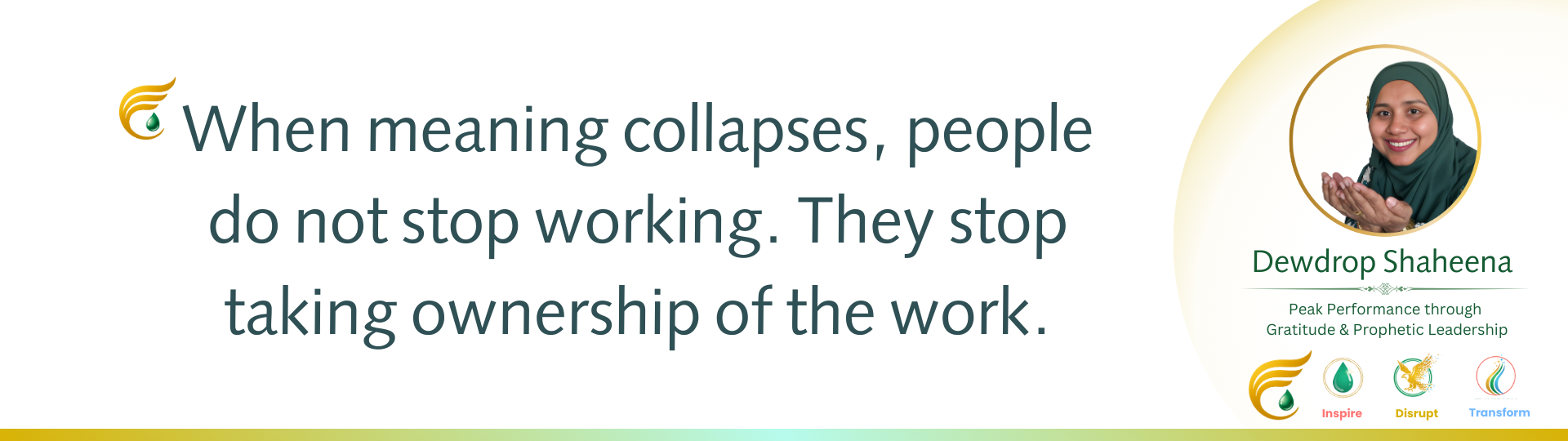
Meaning collapses before motivation drops
In high-pressure environments, especially those with strong hierarchy and respect for authority, people do not disengage first. They protect themselves. When pressure is sustained and meaning is not reinforced, the nervous system narrows. Behaviour shifts from contribution to compliance.
This pattern is particularly visible in Jeddah’s diverse professional environments, where capable, highly educated teams often operate within layered authority structures. Research on workplace voice in hierarchical cultures, including the Gulf region, consistently shows that employees are less likely to speak up under pressure, even when they hold valuable expertise. This mirrors what I repeatedly observe in current engagements: competence remains high, but contributions become cautious.
Leaders often interpret this as a motivation issue and respond with urgency, control, or repetition. In reality, the issue is not effort. It is the loss of meaning.
Amanah as leadership infrastructure
Amanah, in leadership practice, is the lived sense of stewardship. It is the felt responsibility for people, standards, trust, and truth. When amanah is strong, individuals act with ownership. When it weakens, they comply without carrying the work internally.
Burnout, therefore, is not only an energy problem. It is often an amanah problem.
When leaders treat meaning as optional and urgency as primary, teams continue to deliver while slowly disengaging from responsibility. Peak performance becomes fragile, dependent on pressure rather than commitment.
Seven signs that show up when meaning has collapsed under pressure
Meaning loss is subtle but observable.
-
First, urgency increases while importance becomes unclear. Everything feels immediate, but little feels meaningful.
-
Second, targets are emphasised while standards remain vague. People know what must be done, but not what excellence truly looks like.
-
Third, silence replaces discernment. Agreement comes quickly, but honest challenge disappears, especially when senior authority is present.
-
Fourth, gratitude fades. Recognition becomes rare or generic, and contribution goes unnoticed. People stop feeling seen.
-
Fifth, responsibility feels risky. Decisions slow, escalation increases, and people wait for permission rather than act.
-
Sixth, leaders repeat goals, but behaviour does not change. Vision is spoken, yet it fails to translate into daily practice.
-
Seventh, ownership language weakens. “I will” becomes “we should”. Accountability exists structurally, not emotionally.
These signals surface most clearly in meetings, but they are equally present in decision-making, accountability systems, and everyday communication under pressure.
These are not signs of laziness or disengagement. They are signs that amanah has weakened under pressure.
Why pressure accelerates this loss
Pressure itself is not the enemy. Uninterpreted pressure is.
When leaders transmit urgency without restoring meaning, teams experience threat. The nervous system responds by narrowing perception and reducing risk. Over time, this leads to silence, compliance, and burnout, even among high performers.
Many leadership behaviours that surface under stress, such as over-correcting, adding too much value, or withholding recognition, are not character flaws. They are stress responses. Correction alone does not resolve them. Regulation and meaning must come first.
The Amanah Reset leaders miss
Restoring meaning does not require grand interventions. It requires a shift in how leaders respond to pressure in real time.
The Amanah Reset has three movements.
-
First, name what must be protected. Before pushing for speed, leaders must articulate what is entrusted to them in that moment, whether it is people, standards, trust, or truth.
-
Second, reinforce what is being done right. This is where gratitude becomes a leadership discipline rather than a social courtesy. Specific, grounded gratitude restores perspective and steadiness.
-
Third, assign one clear right action. One owner. One expectation. One standard of excellence. Accountability lands differently when meaning is restored first.
This sequence preserves authority without creating fear and protects peak performance without extracting from people.
Where Prophetic leadership fits in modern organisations
Prophetic leadership, applied practically, is not performative spirituality. It is disciplined restraint. It is pausing before reacting, restoring meaning before correcting, and choosing right action over immediate action.
In Jeddah’s leadership contexts, where respect and hierarchy are deeply embedded, this approach is especially powerful. It allows leaders to hold authority while creating psychological safety. It enables teams to speak with integrity rather than fear.
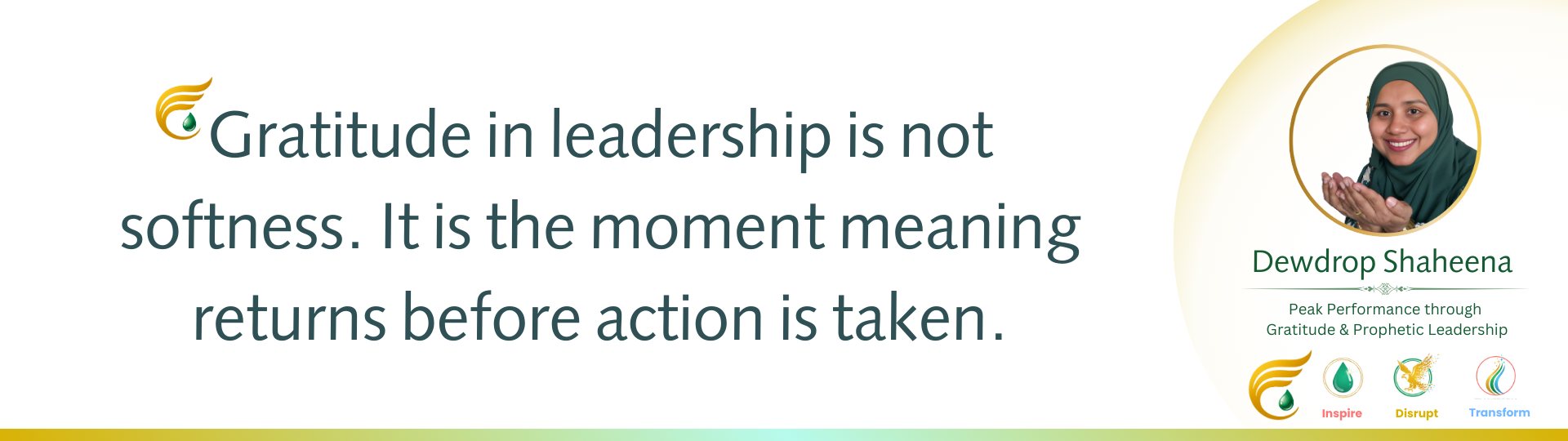
This is how gratitude, amanah, and peak performance converge to prevent burnout.
A reflection for leaders in Jeddah
Before your next decision, conversation, or moment of pressure, pause and ask yourself:
-
Where has urgency replaced importance?
-
Which amanah feels most fragile right now: people, standards, trust, or truth?
-
What would change if you restored meaning before demanding movement?
These are not reflective exercises for later. They are leadership interventions for now.
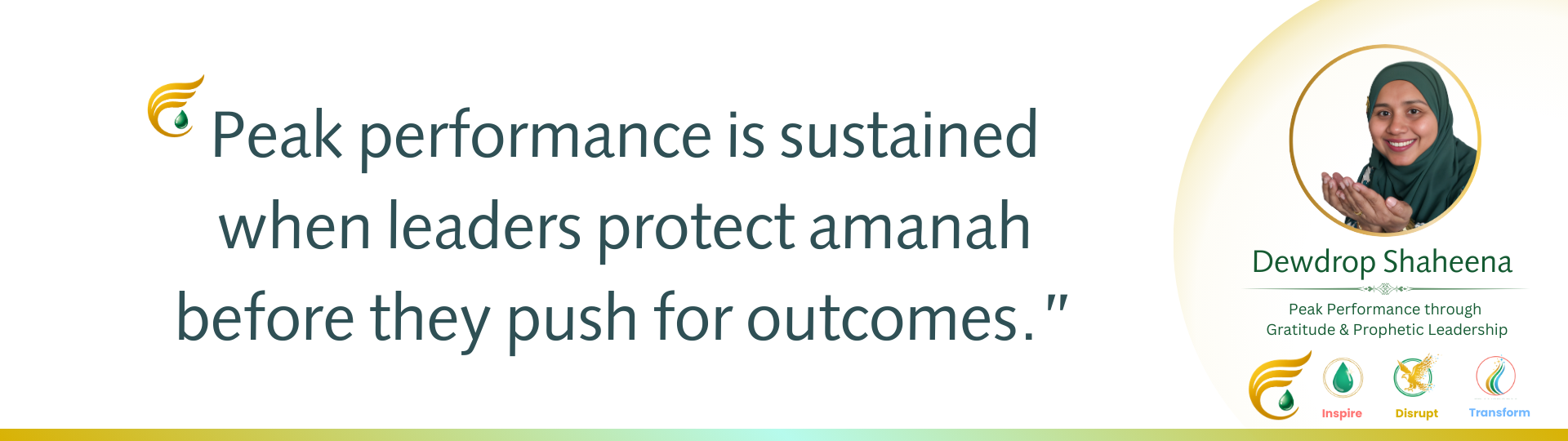
If you lead high-performing teams in Jeddah and care about sustaining peak performance without burnout, begin by reading meaning, not just metrics. Amanah, when restored through gratitude and Prophetic leadership, becomes the infrastructure that allows people to carry responsibility with dignity.
Comment below with one word: people, standards, trust, or truth. Which feels most at risk in your organisation right now?
Peak performance, burnout, gratitude, Prophetic leadership, and leadership in Jeddah are not separate conversations. They are one responsibility.
Feeling inspired?
Discover how my frameworks can help you turn insight into impact.
