
How to Avoid Spiritual Bypassing While Practising Gratitude Shift
Gratitude is powerful, but misused; it can quietly become a way to silence pain rather than heal it.
In my work with high-performing professionals, I see this often. People who pray, reflect, and genuinely want to trust Allah, yet feel stuck, heavy, or ashamed for still struggling. They tell themselves they should be grateful. They repeat Alhamdulillah. They keep going. And underneath it all, the nervous system remains flooded.
This is not a failure of faith. It is a misunderstanding of how gratitude works.
Over the last two years, I have coached more than 1,000 individuals in moments of despair, emotional overwhelm, and perceived blockage. Executives, doctors, professionals on career breaks, corporate escapees, and leaders who look composed on the outside but are privately exhausted. Alongside this work, my Master’s research on an Islamic Coaching Model for Emotional Resilience included in-depth interviews with 11 women. A consistent theme emerged across both contexts: many people were attempting gratitude as a virtue, but experiencing it as a burden. Gratitude helped only when it was applied as a process, not as pressure.
This is where Gratitude Shift™ emerged.
When Gratitude Becomes Bypassing
Spiritual bypassing happens when we rush to meaning before the system is ready to hold it. When we say “be grateful” while the body is still in survival mode. When we attempt surrender without first restoring safety.
In practice, it looks like this:
-
Forcing positivity while resentment simmers underneath
-
Quoting scripture while ignoring emotional signals
-
Repeating gratitude statements without feeling any internal relief
High performers are especially vulnerable to this because they are trained to override discomfort. They know how to perform under pressure. They know how to “do the right thing”. But healing, clarity, and sustainable performance require a different sequence.
Gratitude is not meant to bypass pain. It is meant to reorient perception once the system has steadied.
The Window View and the Mole That Becomes a Mountain
When someone is overwhelmed, their perception narrows. In NLP terms, they are locked into the problem frame. In lived experience, it feels like standing with your face pressed against a window, staring at a single mountain so close that it fills your entire field of vision.
At that distance, even a mole feels like a mountain.
No amount of logic helps here. The mind does not respond to explanation when it is submerged. It responds to regulation. This is why gratitude, when applied correctly, begins not with meaning, but with stepping back.
This insight led me to refine Gratitude Shift™ into a precise, repeatable process.
Gratitude Shift™ — Refined Definition
Gratitude Shift™ verb
To consciously pause in moments of despair, overwhelm, or perceived blockage and step back from the “window view”, where a mole becomes a mountain, reorienting the ʿaql(intellect) towards Allah’s meaning so the heart can return to steadiness and right action.
This is not a mindset hack. It is a leadership intervention for the nervous system.
The CALMER Process
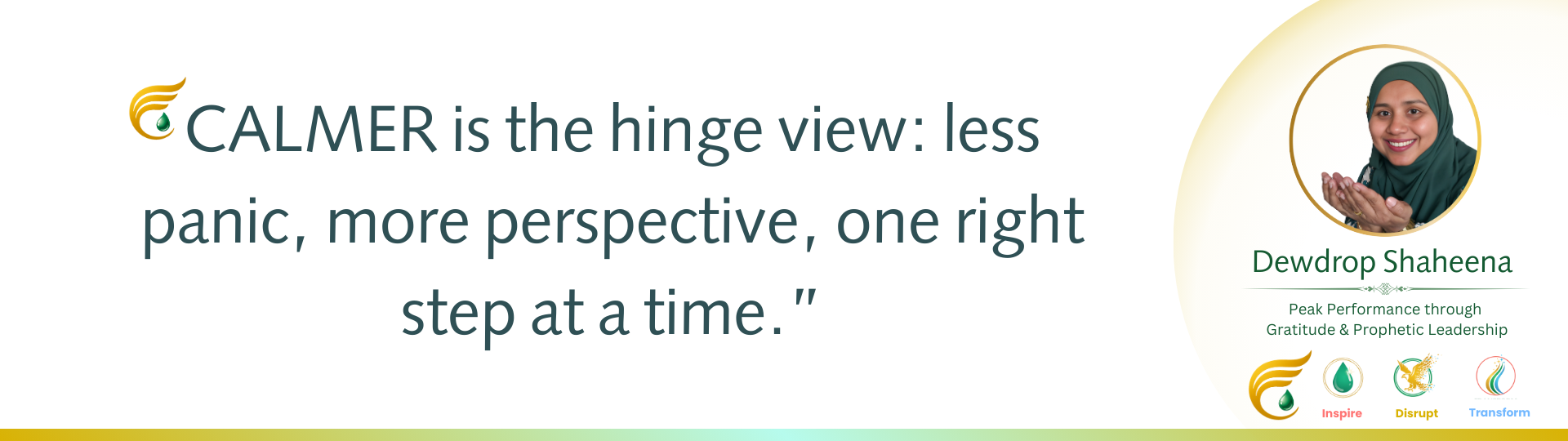
To gratitude shift is to step back five steps from the window and take a “hinge view” through CALMER, six micro-steps designed to restore clarity without bypassing.
1. Clarify
What is the one thing that hurts most right now?
This step prevents vague overwhelm. High performers often say “everything”. CALMER asks for precision. Naming the core pain reduces cognitive load and restores agency.
2. Appeal
Ya Allah, I bring You this. Hold my heart.
This is not problem-solving. It is orientation. The appeal softens the chest and moves the burden from isolation to relationship. Tawakkul begins here, not at the end.
3. Learn
What is this training in me?
Notice the language. Not “Why is this happening to me?” but “What is this shaping?” Learning reframes hardship as instruction rather than punishment.
4. Magnify
What is one thing I can say Alhamdulillah for right now?
One is enough. This is where cognitive reappraisal occurs. The mind regains range. Gratitude is no longer forced; it is located.
5. Execute
What is one small right action I will take today?
High performance requires movement, but movement without clarity leads to burnout. This step anchors insight into behaviour without overwhelm.
6. Recite
اللَّهُمَّ أَعِنِّي عَلَى ذِكْرِكَ وَشُكْرِكَ وَحُسْنِ عِبَادَتِكَ
'O Allah, help me remember You, thank You, and worship You well.'
This closes/seals the loop, returning the process to remembrance rather than rumination.
If gratitude feels difficult, begin with minimum shukr:
-
Alhamdulillah, I can still see.
-
Alhamdulillah, I can still hear
-
Alhamdulillah, Allah hears me
-
Alhamdulillah, I still have the job
Minimum shukr keeps the heart open without pressure.
What I Observed Across 1,000+ Clients
As I applied CALMER consistently with clients over the last two years, clear patterns emerged.
When Gratitude Shift™ was practised correctly:
-
Mental well-being improved, as rumination reduced
-
Emotional resilience strengthened, because emotions were processed, not suppressed
-
Self-efficacy increased, as clients regained a sense of authorship over their responses
-
Performance stabilised, not through hustle, but through clarity
Most importantly, people began to succeed as high performers without sacrificing their inner world. Decisions became cleaner. Boundaries firmer. Trust deeper. They stopped confusing exhaustion with effort and clarity with control.
Gratitude, when structured, did not make them passive. It made them precise.
Why This Matters for Leadership and Performance
The Quran reminds us in (Ibrahim14:7):
لَئِن شَكَرْتُمْ لَأَزِيدَنَّكُمْ
'If you are grateful, I will surely increase you.'
Increase here is not limited to provision. It includes capacity, perception, and steadiness. Gratitude expands the chest. It widens the field of view. It restores access to wisdom under pressure.
For leaders, entrepreneurs, and professionals striving for peak performance, this matters deeply. How you interpret pressure determines how you lead under it. CALMER trains leaders to respond from trust rather than cortisol, from alignment rather than urgency.
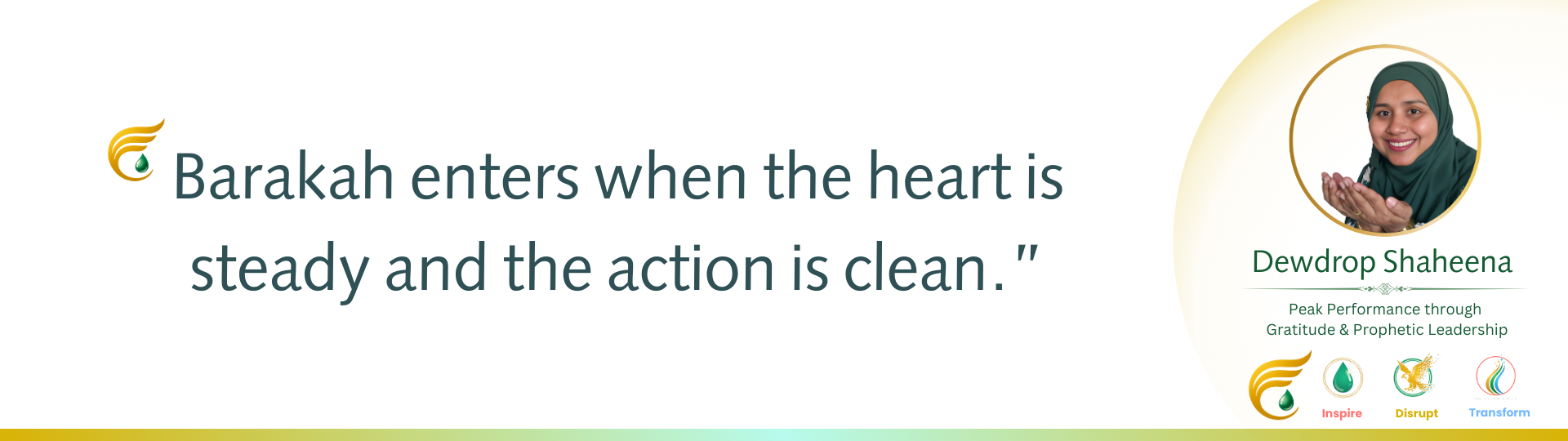
This is Prophetic Leadership in practice. Not reaction, but reflection. Not bypassing, but meaning. Not depletion, but barakah.
A Reflection for You
Pause for a moment.
Before the next email. Before the next decision. Before the next reaction.
Ask yourself:
-
What is the one thing that hurts most right now?
-
What would it feel like to step back five steps?
-
Which CALMER step are you avoiding?
You do not need perfect answers. You only need honesty.
An Invitation
If this resonated, I invite you to reflect in the comments:
-
Which CALMER step stood out to you most?
-
Where might you be rushing to gratitude instead of shifting into it?
Your reflection may be the permission someone else needs today.
This is how high performance becomes sustainable. This is how faith and excellence align. This is how we lead without losing ourselves.
#dewdropshaheena #gratitudebutterflying #emotionalresilience #peakperformance #propheticleadership
Feeling inspired?
Discover how my frameworks can help you turn insight into impact.
