
Why Leaders Lose Authority When They Push Too Soon, and How Gratitude and Prophetic Leadership Prevent Burnout
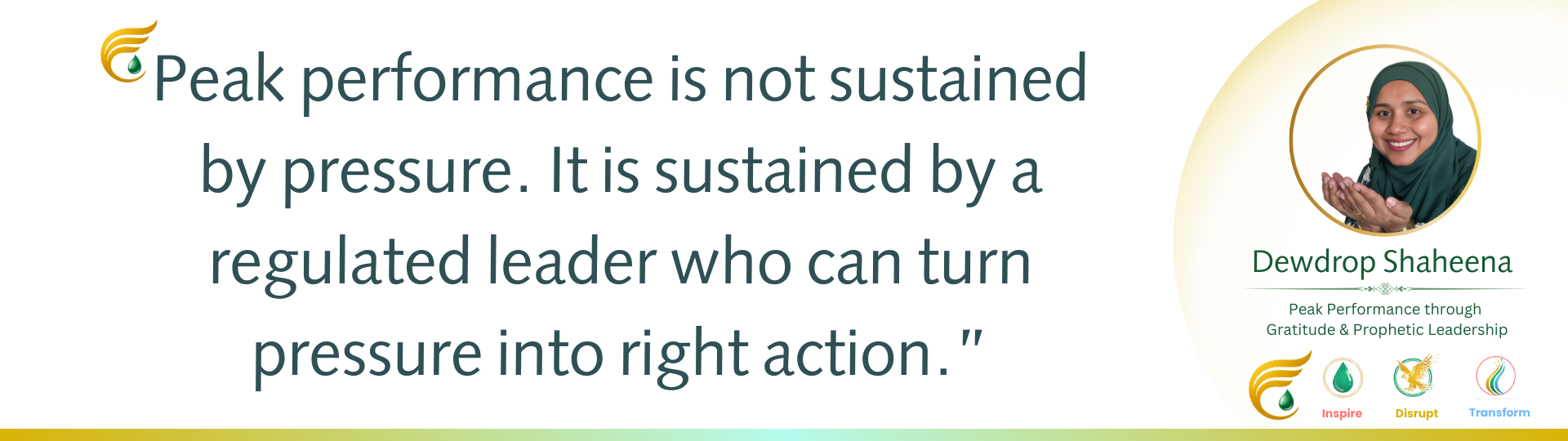
Peak performance is not sustained by pressure alone. It is sustained by leaders who can detect burnout early, regulate themselves first, and then lead with clarity. Yet in most organisations, when results tighten and timelines shrink, leaders do the opposite. They push sooner, talk faster, correct harder, and demand more. It looks like leadership. It feels like urgency. In reality, it often accelerates burnout and quietly erodes authority.
I want to show you what is happening beneath the surface, why high-performing teams brace in meetings long before anyone becomes absent, and how a simple leadership sequence, anchored in gratitude and Prophetic leadership, restores calm execution without lowering standards.
A corporate moment you will recognise
Arif, a senior leader I worked with recently, walked into a Monday meeting with what appeared to be full control. The targets were clear. The board had pressure. The roadmap was ambitious. The team were experienced, loyal, and technically sharp.
The meeting started on time. Arif opened with a tight agenda, moved straight to action items, and asked direct questions. Everyone responded quickly. The tone was respectful. Progress updates sounded positive. On paper, it was peak performance.
But something felt off. The room was flat. People agreed without building. Updates were safe. Risks were underplayed. Questions sounded like compliance. Arif left the meeting feeling productive, only to realise nothing had actually moved. Later that day, Maria and Amjad messaged privately to clarify what they were “really expected to do”. Hidaya quietly postponed a decision.
Arif told me, “I do not understand it. They are capable. They are saying yes. Yet I feel like I am carrying everything.”
This is a defining leadership moment. It is also where burnout begins in organisations that appear high-functioning.
Not because the team stopped working. Because the team started bracing.
The invisible shift that kills performance
When pressure rises, the nervous system narrows perception. This is not a character flaw. It is biology. In that narrowed state, people become more cautious, more reactive, and more protective of their position, reputation, and energy. They still show up. They still deliver. But they conserve their best thinking and offer only what feels safe.
Leaders often miss this because bracing looks like professionalism. The meeting is quiet. The updates are polite. The action items are “accepted”. The leader interprets this as alignment and pushes harder. The team interprets the leader’s push as a threat and braces more.
This loop creates the earliest stages of burnout, especially in high-performance environments where people are trained to endure. The consequences do not appear first as absence. They appear as reduced initiative, reduced innovation, and reduced ownership.
Peak performance cannot survive long in a braced culture, no matter how talented the team is.
Why leaders lose authority when they push too soon
Many leaders think authority is demonstrated through speed, certainty, and correction. Under pressure, they increase all three. They tighten their tone. They add more details. They check more often. They repeat instructions. They “add value” to every idea. They interrupt to keep the meeting efficient.
They believe they are creating clarity. Often they are communicating threat.
When a team is braced, their executive function drops. That means strategic thinking, creativity, and collaborative problem-solving become less accessible. What remains is compliance behaviour. People will agree quickly and privately disengage. They will say yes and quietly minimise risk. They will choose actions that protect them from criticism instead of actions that move the outcome forward.
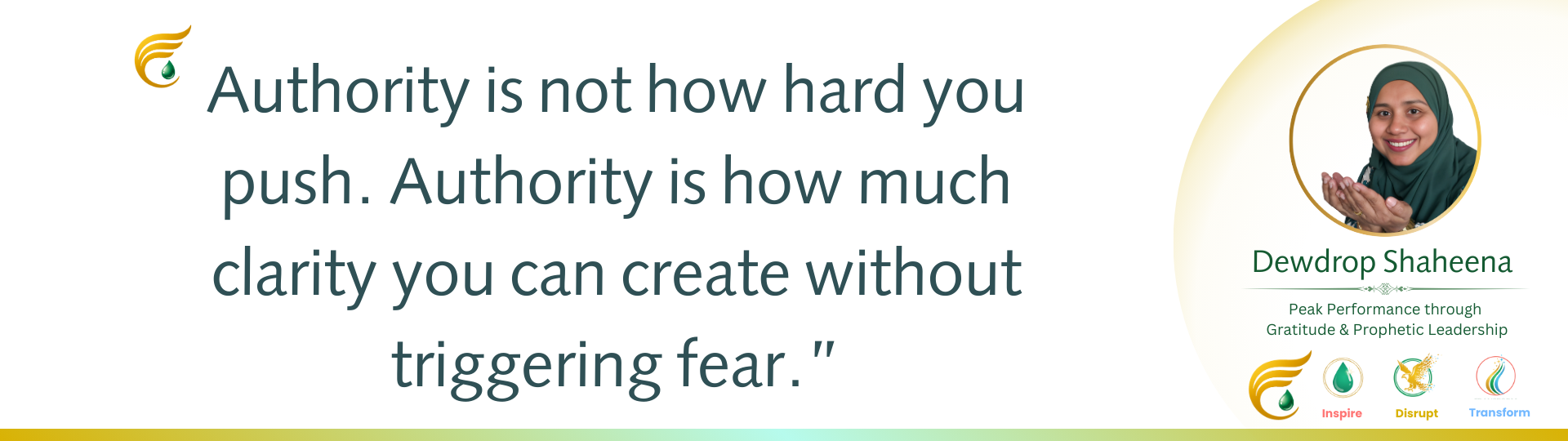
Authority, in the healthiest sense, is the capacity to create coherence. When you push too soon, you create motion without coherence. The team may move, but they do not own the movement. That is not authority. That is forced alignment. It does not scale nor sustain peak performance.
The meeting is your burnout early-warning system
If you want to prevent burnout and protect peak performance in your organisation, start by reading your meetings like a dashboard. Not emotionally. Behaviourally.
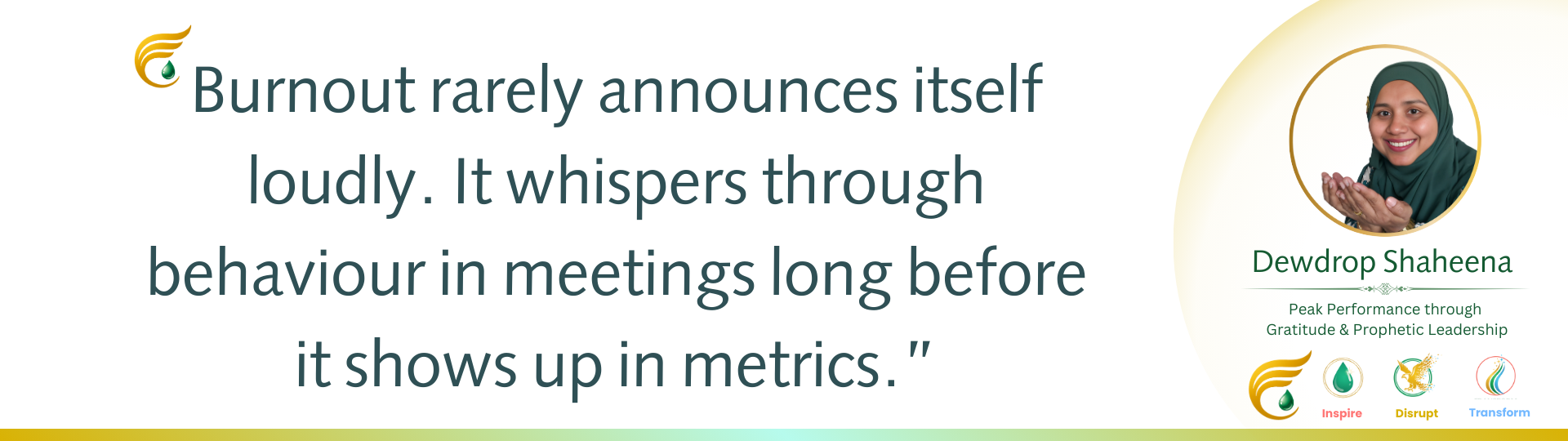
When burnout is brewing, seven signals typically show up early.
-
First, you hear fewer ideas and more agreement. The team stops offering raw thinking and defaults to safe consensus.
-
Second, defensiveness increases. Feedback is met with explanation rather than curiosity. Questions feel personal. The team’s nervous system is protecting identity.
-
Third, micro-delays appear. Replies become slower. Follow-through becomes just enough. It looks like time management. It is often energy conservation.
-
Fourth, escalation rises. Small issues are pushed upwards rather than resolved laterally. People seek authority as a substitute for trust.
-
Fifth, leaders begin over-clarifying. Instructions become longer. Details multiply. Repetition increases. That is a signal that shared understanding is weakening on both sides.
-
Sixth, there is silence after feedback. No questions. No reflection. No ownership language. Silence is not agreement. Silence is withdrawal.
-
Seventh, you hear “yes” without ownership. Commitments are verbal but vague. Deadlines are accepted, but accountability feels thin. The team is complying, not committing.
If you recognise these patterns, do not treat them as discipline issues. Treat them as state issues. That distinction separates leaders who maintain peak performance from those who unintentionally build burnout into their culture.
Why this spread socially
Teams do not only share tasks. They share nervous system states. Leaders transmit state before they transmit strategy. A leader who is braced may still be kind and competent, but their pacing, tone, and attentional narrowness communicate urgency. The team’s nervous system receives it and adapts. People become more careful. They speak less freely. They stop experimenting. They choose safety over excellence.
This is why you can have a “high-performance” organisation on paper that feels heavy in the room. The cost is not visible at first, but it accumulates as nervous system debt. Eventually, it becomes burnout, turnover, conflict, and stalled mastery.
If you are familiar with Marshall Goldsmith’s work on ineffective habits, you will recognise how pressure amplifies certain behaviours. Adding too much value, passing judgment, and withholding recognition are often interpreted as personality traits. In my experience, they are frequently stress responses. Leaders do not need more guilt about these habits. They need a repeatable sequence that restores steadiness before they speak.
The sequence that restores authority without lowering standards
The leadership move that changes everything is not a new policy. It is timing.
When your team is braced, pushing harder feels logical. It is also the wrong order. The correct order is simple.
First, stabilise the room. Second, re-anchor meaning. Third, set standards and next actions clearly.
This sequence works because it mirrors how the nervous system returns to executive function. Once steadiness returns, clarity becomes possible. Once clarity returns, accountability becomes constructive rather than threatening.
Let me make this practical.
-
Step one: Stabilise the room. You stabilise by slowing your pace, softening your tone, and expanding your attention. This is not about becoming gentle. It is about becoming coherent. One sentence can do it: “Let us slow down for one minute. I may be missing something.”
That sentence signals humility and safety. It widens the field. People stop bracing because they sense you are not hunting for mistakes.
-
Step two: Re-anchor meaning. Meaning is what lifts the team out of urgency and back into purpose. This is where gratitude becomes a leadership tool rather than a personal emotion. Gratitude in organisations is not praise. It is perspective. It reminds the team what is working, what is entrusted, and what matters.
A leader can say: “Before we decide, let us name what is going well and what we are protecting. Then we will address what needs to change.”
This restores cognitive range. It prevents the nervous system from interpreting pressure as threat. It is also where Prophetic leadership becomes visible: pause, reflect, then act.
-
Step three: Set standards with precision. Once the room is stable and meaning is restored, you can hold standards without triggering defensiveness. You can say: “Here is what excellence looks like. Here is what we are deciding today. Here is the next action, the owner, and the deadline.”
Notice what changed. You did not lower standards. You changed the internal conditions under which standards are received. That is authority.
Where gratitude and Prophetic leadership fit, without becoming “soft”
For high-performing professionals, gratitude can be misunderstood. Some equate gratitude with settling. Others equate gratitude with politeness. In my work, gratitude is neither. Gratitude is a perceptual reset that widens the mind and steadies the heart so the next action is correct.
Prophetic leadership, in practice, is not performative spirituality. It is a disciplined way of responding. It is pausing before reacting, returning to meaning before correcting, and choosing the right action rather than the fastest action. That is exactly what peak performance requires under pressure.
You cannot build mastery in an organisation if your default mode is urgency. Urgency has a place in true emergencies. Many workplaces live in urgency as a culture. That produces motion, not mastery. It produces output, not excellence. It produces short-term wins, followed by burnout.
Gratitude, when applied as leadership, breaks urgency culture. It restores perspective. It signals safety. It returns the team to their best thinking. It also protects the leader from becoming the source of pressure that harms the team.
A simple in-meeting repair script leaders can use today
If you want one practical script to apply immediately, use this three-part reset inside a meeting when you feel the room tightening.
-
Start with stabilising: “Let us pause for one minute. I want to make sure we are seeing this clearly.”
-
Then re-anchor meaning: “What is the outcome we are protecting here, and what is already working that we should not break?”
-
Then set standards: “Here is the decision for today. Here is the owner. Here is the deadline. Here is what ‘good’ looks like.”
This sequence reduces bracing without lowering performance. It restores ownership. It makes the room breathe again.
This is how you prevent burnout early, without waiting for absence. It is also how you build a culture of sustainable peak performance.
A reflection for high performers
If you lead people, your state is part of the system. Your pace, tone, and attention teach the team how to behave under pressure.
Before your next meeting, consider three questions.
-
What is the most common bracing signal on your team right now? Is it silence, defensiveness, or compliant agreement?
-
Where do you tend to push too soon? Do you correct quickly, over-clarify, or add urgency?
-
What would change if you led the first two minutes of every meeting for steadiness, rather than speed?
These are not soft reflections. These are strategic levers. They determine whether your team produces compliance or contribution.
My invitation
If you are committed to peak performance and you want to prevent burnout in your team, start by reading your meetings differently. Bracing is data. It is not disobedience. When leaders interpret pressure correctly, they can respond in ways that restore clarity, strengthen ownership, and protect culture.
-
Comment below with a number. Which signal is most true on your team right now, 1 to 7.
-
If you add one line on what you are seeing, I will reply with one practical adjustment you can make inside your next meeting.
Peak performance, burnout, and gratitude are not separate topics. They are one leadership conversation. The leaders who master this conversation build organisations that achieve results without sacrificing people, and that is the essence of Prophetic leadership in modern work.
Feeling inspired?
Discover how my frameworks can help you turn insight into impact.
